
Special moves and combos
Issue 298: Mastery starts with button mashing

One of the many fond memories I had growing up was earning the five stars from Pizza Hut’s Book It program to get my Pepperoni Personal Pan Pizza. As we waited for our food, my mother would gift my brother and I a few quarters to play an arcade game of our choice. Among the rotation of The Simpsons Arcade Game and Altered Beast, there was also Street Fighter II.
Down, down-forward, forward, punch.
I didn’t know what those inputs meant the first time I saw a fireball come out of Ryu’s hands. I knew it looked like the most powerful thing a person could do with a quarter.
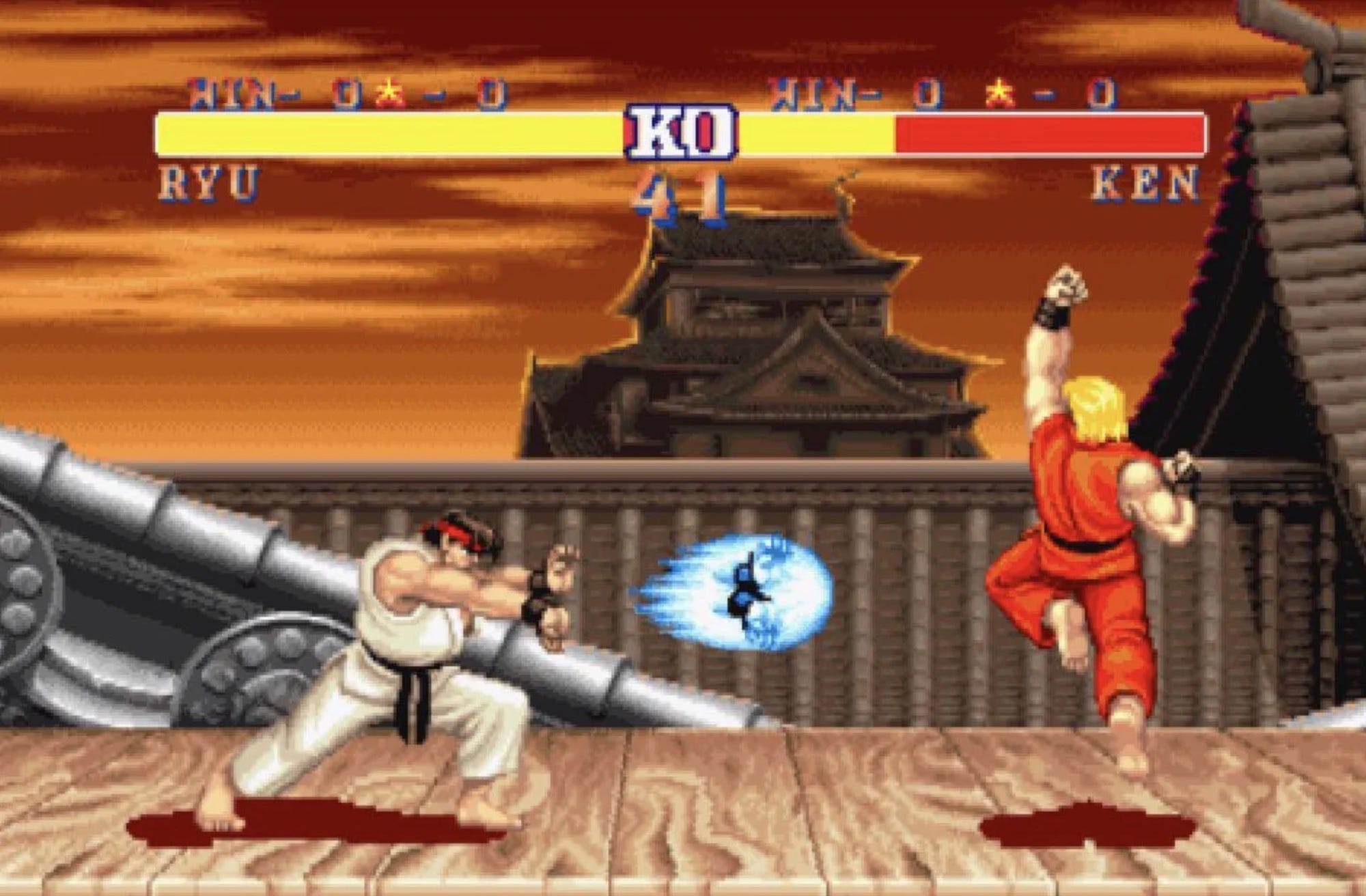
I became obsessed with fighting games. My brother and I would buy any fighting game we could on our Sega Genesis to unlock the special moves. Going to the arcade became a frequent hobby. Imagine the joy when we discovered an arcade called Nickel Palace, where for a small entry fee you could play any game for 5 cents instead of a quarter.
There was a new game in town: Mortal Kombat. A hyper-realistic and violent challenger to Street Fighter. I decided to give it a try. Of the seven characters available, I picked the blue ninja, because you always pick the ninja. Sub-Zero.
I had zero onboarding. No manual on the carpet, no time to study a move list. The controls were a bit different than Street Fighter, but I tried the Hadouken input anyway.
Down, down-forward, forward, low punch.
Sub-Zero threw a freeze projectile and froze my opponent in place. That moment did something to my eight-year-old brain that I didn’t have the vocabulary for at the time. The input wasn’t a Street Fighter thing. It was a grammar. A motion that meant “throw something” across an entire genre. The move list in the manual had been teaching me the wrong lesson; I thought I was memorizing facts about Ryu. I was actually learning a language.
Special moves are shortcuts and patterns
The same grammar shows up far outside the arcade. Early Photoshop users found their Hadouken moment when they learned keyboard shortcuts. Cmd-J to duplicate a layer. Cmd-Option-Shift-E to stamp visible. The first time you string them together to flatten a comp, dupe it, run a filter, and mask the result without ever touching the mouse, you feel the same thing the kid felt pulling off a fireball in the arcade. The action collapses in time. Six menu trips become one fluid motion.
Macros are where that fluency turns into combos. Actions in Photoshop, snippets in code editors, Shortcuts on the iPhone, custom skills for Claude. A sequence of moves you can fire as one. Designers wiring up multi-step prompts to a hotkey are running the same playbook as the Killer Instinct kid memorizing a 47-hit Ultra, finding the inputs that, in sequence, produce a result larger than the sum of their parts.
The cognitive science calls this chunking. With enough repetition, what used to be a string of discrete keystrokes becomes a single learned phrase. The hand stops asking what comes next; it already knows. The work migrates out of working memory, where every step costs you attention, and settles into procedural memory, where the sequence runs on its own. Your mind is freed up for the thing the hand is in service of.
Special moves and combos are patterns made portable. Skills you’ve practiced enough times that they no longer cost you attention.
Developing your move set
Your move set develops the way any craft does: through experimentation and practice, figuring out which moves fit your style of work. A Design Engineer’s move set looks different from an Icon Designer’s. A researcher synthesizing interviews works from a different vocabulary than a brand designer kerning a wordmark. The moves are shaped by the surface area of the craft.
The way you build a move set is the same way the arcade kids built theirs. You try things. You fail a lot. You watch people who are better than you and steal what they do. You read the manual. You spend a stretch of time being deliberately bad at something in order to be quietly good at it later.
Deliberate practice is the part nobody romanticizes. Anders Ericsson’s work on expertise pointed at something specific: the people who get great at something practice harder on the parts they’re worst at, with feedback they can act on. Competence is where most people stop. For experts, it’s where the real work starts. You don’t become an expert unless you’ve been a novice for a long time.
Mastery without mashing buttons
Every fighting game player started by mashing buttons. Random inputs, hoping a fireball would come out, occasionally winning by accident. Mashing is how you find the inputs in the first place; it’s the entry point to noticing that some sequences do things and most don’t.
Pick a move. Practice the input until your hand knows it. Find the next one. String them together.
Ha, those photoshop shortcuts. What a feeling. 🙌
Never wished a notification would come with the “Hadouken!” audio but hey there’s a first for everything!