
Design leadership plate tectonics
Issue 302: The underlying disruption that'll soon hit

When you look at the future geology of design leadership, there are two forces of nature hitting the industry: multi-modal and multi-generational. The first is the AI and agentic era of software we find ourselves in. Software and business models are being re-written as we speak to be AI-native. The second is there is a generational shift in the pipeline of professional designers. One group is emerging in their career and the other are at the end of theirs; retiring or fading into obscurity. A lot of people think there is still a lot of time. I do not.
This crustal compression of the design craft is where I lose sleep. In this year alone, some of the best design leaders I know retired from the industry. Finding strong design leadership is rare as it is, and we’re losing the good ones rapidly. At the same time, the role is also changing rapidly. The combination of experienced leaders retiring and this paradigm shift of AI-literate design capabilities makes me believe in the next two years, there is going to be a seismic series of events that’ll change the entire landscape of design leadership.
I believe there are three tectonic stages that’ll happen: the initial uplift, sustained thrust, and a new mountain range forming. Before I go into detail on the three, let’s look at the current state from my perspective.
Current state
It might feel things are moving fast and advancing rapidly. However, I believe we’re still at the slow stage, and every month is going to continue compounding. We’re barely at stage one of the initial uplift; imagine what the next stages will feel like. Though many like myself believe the material of intelligence bring immense positive change, the current state is nascent.
The tokenomics is immature right now. Reading the headlines about AI is a clear indicator that its bounds aren’t widely understood yet and are still being figured out. In the State of Teams 2026 report by Atlassian’s Teamwork Lab, 89% of executives say AI is speeding up work, but only 6% can point to specific ROI. The same companies that were setting leader boards and Tokenmaxxing are taking another look at their perspective on if they are getting value. The long-term use cases and correlation to transformation are still being written.
The second theme in the current state is most AI-literate Heads of Design are working at new companies more than at established companies. Top talent in various ranges of their career journey are feeling the FOMO of working at a frontier lab and being at a place where they can learn the material of intelligence. They are joining emerging companies, starting their own, or in some instances taking a break to go deep on designing with AI.
Finally, the shape of leadership orgs at established companies are still the same. Even as companies are experimenting with AI, the org structure, decision making, and operational rituals are optimized for the previous era.
The tectonic stages
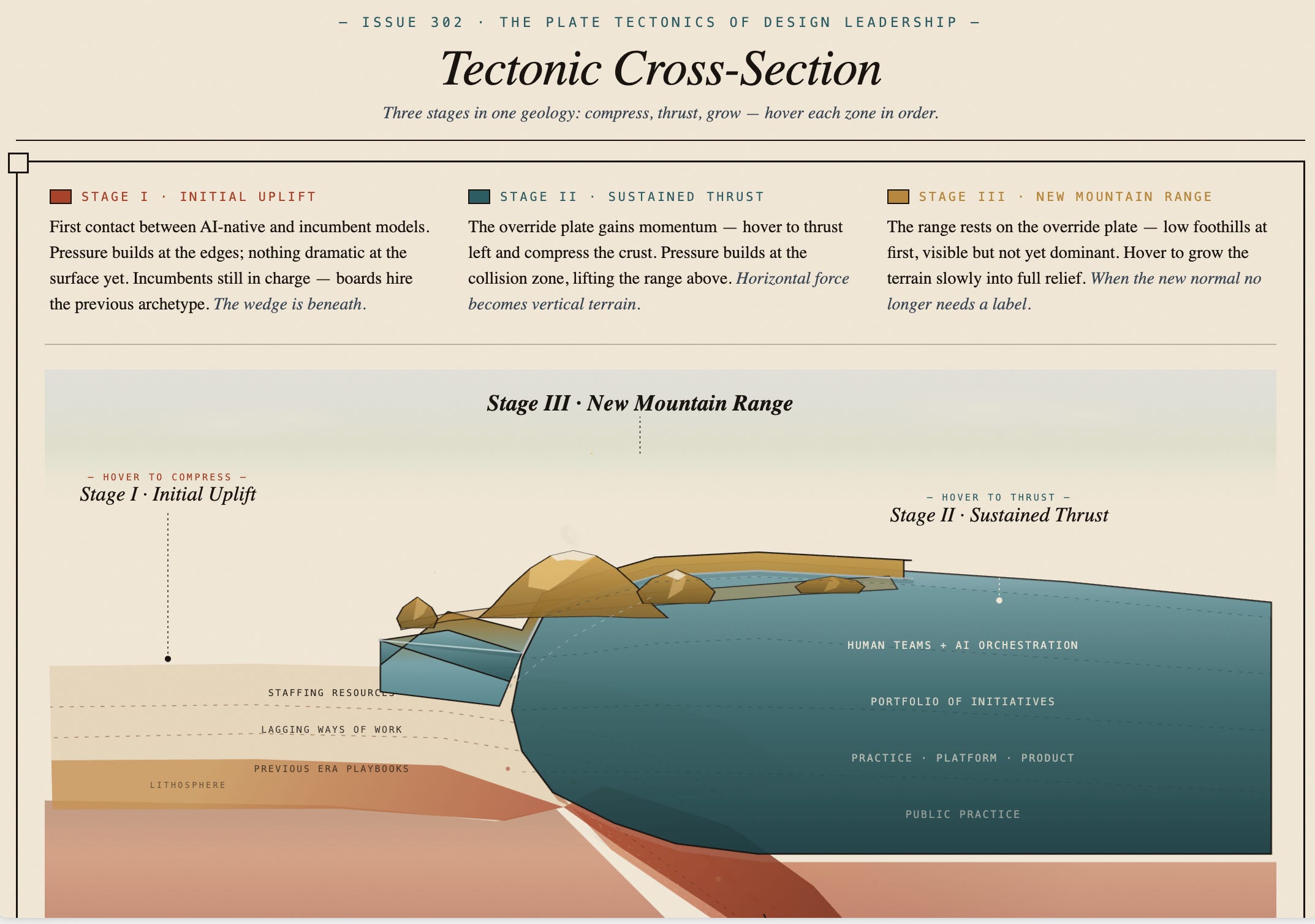
Let’s look at the three stages coming for design. To better illustrate the stages, I made a interactive page with Cursor to illustrate the concept.
Stage 1: The initial uplift
This is the beginning of the scaling era of AI; the first encounter between the AI-native plates and the incumbent. Pressure builds at the contact zone and the edges of how we work, but nothing dramatic shows at the surface.
We’re seeing a small number of mid-career designers working in public. They’re fearless in sharing their learning journey by publishing newsletters, posting demos, and giving talks about what they’re learning. It feels like the 2010s in San Francisco for the elder millennials.
Though they’re still developing and I don’t think they’re ready for senior seats yet, they will be the next cohort of leaders. I know because I’ve been scouting them.
In this stage the incumbents are still in charge and boards are hiring the archetype of the previous era. Underneath, the AI-native plate is wedging beneath, and I sense a major earthquake coming. However, it’s easy to dismiss. We might think, “this is just a moment” or, “this is only for ICs”, but it’s coming for managers and people in leadership roles.
Stage 2: Sustained thrust
In the next two years, I believe the overriding plates have enough momentum and force to become visible; a first look at the new mountain range. The first wave of design execs who understand the material of AI get installed at challenger companies—vibe coding tools, agent platforms, and AI-native startups disrupting the SaaS dinosaurs of before. They likely aren’t promoted within legacy orgs but hired into new ones. The opportunity for legacy orgs is to land these emerging leaders.
The summit composition becomes legible and less theoretical. These are leaders who can direct human teams as well as orchestrate AI. They manage a portfolio of initiatives to change the business instead of staffing resources to maintain the status quo.
This is where the melt zone activates. We’ll see designers get submerged into the molten lava of irrelevance. They get recycled into founding designers, go back to individual contributor, or leave the industry entirely.
The signal of sustainability in this stage is when the senior design execs at traditional companies are AI-native in their understanding of Practice, Platform, and Product.
Standard credentialing feels like it’s lagging at this point, but signals of market validation emerge.
Stage 3: The new mountain range
As a result of the previous two stages, what emerges is not only a single peak of role and scope, but a mountain range of various ones. I believe we’ll see multiple archetypes that will be recognizable in the future: design GM, AI-native exec, studio operator, design-founder hybrid. New programs, new firms, and new credentialing institutions emerge specifically for AI-native design leadership.
This is where subduction gets real. The signal of sustainability here is when people no longer say, “AI-native” and it’s normalized as part of the work. This is the stage we’ll know who is left from the previous era.
What happens to design leaders
So here is the question to answer: what will happen to the current design leaders? There are three likely outcomes from this. Leaders adapt, which I hope many will. There is realization that the most important aspects of design foundations will modernize with the tools, ways of working, and company shape.
The second outcome is leaders resist and don’t want to change. There can be multiple reasons. Perhaps they don’t want to do anything with AI and choose to something else; totally valid. However, there are others who simply refuse to change their perspective. As physicist Max Planck once said about his field, "Science advances one funeral at a time.” I remember a college instructor who had no interest in teaching web design because they thought the web was not the future.
The final outcome is the cold hard truth; leaders become irrelevant. Even if there is a desire to adapt, they don’t adopt and apply the new way of working.
I’m an optimist, and my points are not about doom and gloom. I’m calling out the real existential threat on design leadership if we collectively don’t do anything. If you’re feeling in the leaders become irrelevant bucket, it isn’t too late. Every day in AI feels like an equalizing moment so there is no concept of being ahead.
Fall in love with the craft again. Many leaders worked in the blitzscaling and “grow at all cost” era. This messed up a lot of managers because their impression was the sole purpose of design management was having 1:1s and supporting people. Though it’s a critical part of the role, there is so much more. In order to lead in the new era with new materials, you have to lead through the craft.
Next, it’s critical to develop the next generation of leaders. I’m very concerned about the succession pipeline in the industry. Though the multi-modal generation will come with immense talent and skill, they haven’t seen the trials and tribulations of industry shifts, org challenges, navigation politics, and operating as an executive. This is where the current leaders in seat have much knowledge and wisdom to pass down. Don’t speed date mentor on ADP List, pick one person who you’re going to support and grow for the next era.
Here is the great challenge. In order to be the right person to lead the industry into Stage 3, you have to be both. You cannot lead as a talented designer until you’ve faced the trials and tribulations of operating and company building. At the same time, having twenty years of experience and being around for a long time does not mean you have the relevant skills and knowledge to lead in the modern era.
There is a huge shake in the plate tectonics of design leadership coming. We’re still going through the tech factory reset, and it’ll be a few more years of disruption. My challenge is to stop letting things happen to you and make things happen.
As I tell my teams, to survive disruption, you must become disruption.
Hyperlinks + notes
The hidden AI tax nobody is talking about but everyone feels | Atlassian Teamwork Lab
Top Stories: WWDC 2026 Recap With Siri AI, iOS 27, macOS Golden Gate, and More → macOS Golden Gate feeling like the Snow Leopard release of this era
David Hockney, iconic British artist known for his colorful landscapes and pool scenes, dies at 88 → RIP to an all-time great artist
The Webflow brand and marketing alumni group is something special
Call for speakers is open for SwiftCon in Berlin